
Blog | Baumgartner Capital | SFO, Venture Capital, Private Equity & Advisory
WE ARETrustworthyReliableResilientConfidentVisionaryFearlessSmartFastBaumgartner Capital
A FEW THINGS TO KNOWOUR BLOG
Table of Contents
- COUNTRIES WITH HARDER CURRENCIES
- SOUND MONEY
- WHY GOLD IS SOUND MONEY
- WHY SILVER IS A HYBRID: COMMODITY AND STORE OF VALUE
- HISTORICAL POSITION OF THE PRINCELY HOUSE OF LIECHTENSTEIN ON A GOLD-BACKED CURRENCY
- LIECHTENSTEIN BECOMES THE 191ST MEMBER OF THE IMF
- THE HIDDEN GOLD BAN: HOW THE IMF EXCLUDES THE GOLD STANDARD THROUGH ARTICLE IV (2B) OF ITS STATUTES
- THE IMF WARNS. BUT WHO, EXACTLY?
- PHYSICAL DELIVERABILITY IN THE GOLD FUTURES MARKET
- M&A IN THE GOLD MARKET: CONSOLIDATION, ACCESS TO CAPITAL AND STRATEGIC REPOSITIONING
- LIECHTENSTEIN’S TAX CD 2.0 MOMENT: REGISTER OF BENEFICIAL OWNERS COMPROMISED
- IN FOCUS: STATEMENT ON THE STRATEGIC ENVIRONMENTAL ASSESSMENT FOR THE DESIGNATION OF WIND ENERGY AREAS IN LIECHTENSTEIN
2020
CURRENCIES
Kai Baumgartner
COUNTRIES WITH HARDER CURRENCIES
Countries with stronger currencies and less interventionist economic policies provide more attractive conditions for venture capital investors, who depend on long-term stability and market transparency—especially when compared to the Eurozone and Germany.
We also invest in alternative systems for preserving and storing value in line with the Sound Money movement, including gold, Bitcoin, and other monetary assets that meet sound money principles.
Persistently high inflation in the Eurozone, amplified by expansive fiscal and monetary policies, has eroded confidence in the Euro as a stable currency and increased the risk of losses for long-term investments. Rising public debt and the growth of transfer payments within the EU create fiscal “moral hazard”, further undermining long-term economic stability.
Germany, in particular, is losing its attractiveness as an investment destination due to regulatory hurdles, rising taxes, and high energy costs, all of which damage its competitiveness. According to Austrian Economics, artificially low interest rates set by the European Central Bank distort capital allocation and foster economic bubbles—ultimately weakening the risk-return profile for venture capital.
2021
CURRENCIES | GOLD STANDARD
Kai Baumgartner
SOUND MONEY
Sound money is characterized by the following fundamental properties:
Stability of Value: Sound money retains its value over time and is largely protected from inflation and deflation. This fosters trust and enables reliable preservation of purchasing power.
Scarcity and Limitation: A limited supply (e.g., gold or Bitcoin) prevents arbitrary expansion of the money supply, which could diminish its value.
Recognition and Acceptance: Sound money is widely accepted by a broad community and functions effectively as a medium of exchange and economic foundation.
Divisibility and Fungibility: It can be divided into smaller units, with each unit having the same value as any other, facilitating flexible trade.
Transportability and Durability: Sound money must be easy to transport and store without losing value or quality.
Neutrality: It should be immune to political manipulation and operate independently of government or institutional intervention to maintain long-term trust.
Examples like gold or Bitcoin fulfill many of these criteria, while fiat currencies are often criticized for their unlimited supply and susceptibility to political interference.
If you're considering precious metals gold, silver, palladium, or platinum as a reliable hedge against risks all fiat currencies like EUR and USD face, we warmly invite you to join the Swissmade flexgold community.
2021
CURRENCIES | GOLD
Kai Baumgartner
WHY GOLD IS SOUND MONEY
Once we understand what sound money is, a natural follow-up question emerges: which asset comes closest to this ideal in the real world? Across history and across cultures, the answer has been remarkably consistent. Gold has functioned as money for thousands of years and has outlived every paper currency ever created. It is the monetary asset that has proven least vulnerable to devaluation and confiscation.
Gold as the Oldest Form of Base Money
Long before central banks, fiat currencies, and digital payment systems, gold served as final settlement. Empires, city-states, and trading networks used it as a universal reference point for value. While political systems and legal frameworks changed repeatedly, gold’s role as money survived regime changes, wars, and debt restructurings. That continuity is not an accident; it reflects the properties outlined in the article on Sound Money: scarcity, durability, neutrality, and broad recognition.
RWA-backed Money vs. Fiat Money
Historically, monetary systems have taken two basic forms:
RWA-backed currencies: Paper claims that were legally redeemable for a fixed amount of gold or another scarce asset such as silver. The paper was a promise; the gold was the anchor as a Real-World-Asset (RWA).
Fiat currencies: Money issued by decree, not backed by any specific asset and not limited by a natural constraint. Confidence rests on trust in the issuing authority and its future policies.
Under hard-asset-backed systems, governments and banks promised to exchange paper money for gold at a fixed rate. As long as those promises were credible, the system functioned. The problems started whenever the amount of outstanding promises (debt) grew faster than the underlying stock of gold.
What Happens When Debt Outgrows Hard Money
Whenever too much debt accumulated in a gold-linked system, societies faced an uncomfortable choice. Either they honored the gold backing and allowed a deflationary cleansing of bad debt, or they broke the link and devalued the currency.
In simplified terms, the choice was:
a) stick to gold convertibility and accept defaults, bankruptcies, and deep deflation, or
b) suspend or weaken the gold link, create more money and credit, and accept devaluation and inflation.
Both paths produced crises, but of a different kind. Under option (a), nominal contracts were honored in gold terms, but many debtors failed. Under option (b), nominal debts survived, yet the currency itself was weakened. Historical breaks in gold-linked systems in the 20th century, such as the 1933 and 1971 episodes, followed exactly this pattern and reset the system at higher price levels.
The Fiat Era and the Logic of Monetary Expansion
Since 1971 Bretton Woods, the global system has been purely fiat-based. Central banks can expand their balance sheets without a hard asset constraint. When public and private debts become unmanageable, the textbook response has been the same across countries and decades: create additional money and credit to avoid a deflationary collapse.
The result is familiar: rising inflation risks, recurring currency devaluations, and a steady erosion of purchasing power over time. In such environments, gold tends to reassert itself as an alternative form of money. Its price does not “rise” in a fundamental sense; rather, fiat units fall against an asset whose supply cannot be printed.
Gold vs. Paper Debt Money
From an investor’s perspective, most modern “money” is actually debt: government bonds and bank deposits that promise future payment in fiat currency. These instruments can offer interest. Gold does not. This leads to a simple but powerful rule of thumb:
When the interest you receive on paper money more than compensates for inflation and devaluation risk, holding fiat and bonds can be attractive. When the real return after inflation and credit risk is poor or negative, gold becomes relatively more appealing.
Over very long periods, gold has roughly kept pace with the cost of living. Its real return has been low but positive, similar to cash, and historically it has often been negatively correlated with short-term interest-bearing instruments. That makes it a useful counterpart to cash in a portfolio: together, they form a liquidity reserve that behaves robustly across very different macro environments. This explains why gold is now the second-largest reserve asset held by central banks worldwide. Even institutions that operate the fiat system still rely on gold as their ultimate collateral.
Confiscation Risk and Counterparty Exposure
A key reason why gold qualifies as sound money is its low confiscation and counterparty risk—provided it is held directly and securely. Unlike bank deposits, bonds, or digital claims, physical gold does not depend on someone else’s promise to pay. It cannot be defaulted on or restructured.
Furthermore, properly stored gold is difficult to seize. It cannot be hacked digitally, frozen with the click of a mouse, or written down by decree in the same way as nominal financial assets. History shows that in periods of crisis—whether financial panics, hyperinflations, or monetary and economic wars—states often resort to capital controls, special taxes, or outright expropriations. In those situations, movable, bearer assets such as gold have repeatedly offered a last line of defense.
Whenever the risk of confiscation rises—through sanctions, war, or extreme taxation—gold has tended to preserve value better than almost any other asset. Its role as “crisis money” is not theoretical; it is grounded in centuries of experience.
Gold as an Investment: Strategy Before Market Timing
For portfolio construction, it is helpful to think of gold not as a speculative trade but as a monetary building block alongside cash. The starting point is strategic asset allocation: What share of total wealth should be held in assets that do not depend on someone else’s solvency?
Most investors try to time gold tactically—buying when they expect it to rise and selling when they expect it to fall. Empirically, very few succeed with this approach. A more robust framework is to decide on a strategic allocation to gold and then adjust only cautiously, if at all.
In a diversified portfolio, a strategic allocation in the range of 3% to 20% of total assets is often a reasonable corridor, depending on the investor’s risk tolerance, currency exposure, and the composition of other holdings. At the lower end, gold functions mainly as insurance; at the higher end, it becomes a core pillar of wealth preservation.
When to Overweight or Underweight Gold
There are environments in which increasing gold exposure makes sense. These include periods when:
• debt levels are very high relative to income and growth,
• central banks are forced into aggressive monetary expansion,
• confidence in government bonds is visibly eroding, or
• capital controls, sanctions, or other forms of financial repression are becoming more likely.
In such regimes, the risk that fiat money and debt will be devalued or partially confiscated increases, while the relative attractiveness of an unencumbered asset like gold rises. Conversely, in phases of genuine fiscal restraint, positive real interest rates, and low confiscation risk, it can be rational to hold less gold and more productive assets.
Conclusion: Treat Gold as Fundamental Money
The essential point is simple: gold should be viewed as fundamental money, not just as a speculative commodity quotation. It has a unique track record of preserving purchasing power over long horizons, especially in times when debt, inflation, and confiscation risks are elevated.
Most investors today hold little or no physical gold. Their wealth is concentrated in claims on the very system whose weaknesses they fear. From the perspective of sound money, that is an unnecessary concentration risk.
By holding a meaningful, well-defined share of gold as base money—alongside cash, productive assets, and entrepreneurial investments—investors can build a portfolio that is better prepared for both the continuation of the current fiat regime and its potential disruption. [1]
References
[1] Ray Dalio “Gold Is The Safest Money”
2021
COMMODITIES | SILVER
Kai Baumgartner
WHY SILVER IS A HYBRID: COMMODITY AND STORE OF VALUE
Industrial Demand Matters More Than History
The gold–silver ratio (GSR) is often used to argue that silver is historically undervalued. In the sufficiently well-documented past, the GSR ranged between 1:2 and 1:15, with 1:15 potentially representing the “historical long-term optimum”. With the ratio still at elevated levels, calls for a return to “historical norms” have resurfaced. Yet this framing overlooks a decisive structural shift: silver is no longer primarily a monetary metal. It is a strategic industrial input.
Gold’s demand profile remains largely monetary, driven by central banks and investors. Silver, by contrast, has evolved into a hybrid asset. Today, more than half of annual silver demand comes from industrial applications, including solar energy, semiconductors, electric vehicles, medical technology, and defense systems.
This change fundamentally alters how the GSR should be interpreted.
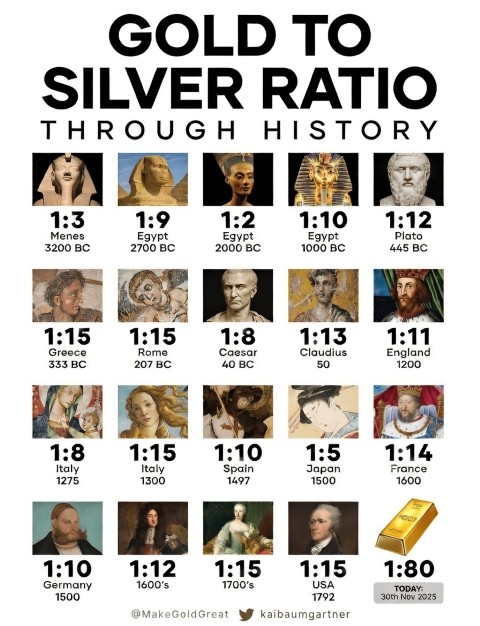
A Scenario-Based Outlook
1. Status Quo: Gradual Industrial Growth (GSR ~60–90)
In a stable macro environment, industrial silver demand rises steadily with electrification and digitisation. Silver performs in absolute terms, but the ratio remains structurally elevated.
2. Industrial Acceleration: Energy Transition Pressure (GSR ~40–60)
Faster solar deployment, new energy storage systems for e-mobility, AI computing, and limited mining supply create physical tightness. Silver outperforms gold, compressing the ratio without any monetary reset. This is one of the most plausible medium-term scenarios.
3. Inflation & Monetary Stress (GSR ~30–50)
Persistent inflation increases demand for tangible assets. Silver benefits both as an inflation hedge and as an accessible alternative to gold, leading to stronger relative performance.
4. Monetary Reset (Tail Risk) (GSR ~15–25)
A return to historical ratios would require explicit remonetisation or systemic breakdowns. Historically, such ratios were legally fixed, not market-driven. This remains optionality, not a base case.
Key Takeaway
Silver does not need a return to historical ratios to be relevant. Its strategic importance increasingly derives from supply rigidity meeting unavoidable industrial demand.
Gold remains the anchor. Silver provides the convexity.
History is context — not a forecast. Scenario 2, 3, 4 or a combination are more likely to happen.
Note
This article was updated on November 30, 2025 with a current graphic.
2024
CURRENCIES | LIECHTENSTEIN
Kai Baumgartner
HISTORICAL POSITION OF THE PRINCELY HOUSE OF LIECHTENSTEIN ON A GOLD-BACKED CURRENCY
Liechtenstein’s Monetary Policy and Gold Tradition
The Princely House of Liechtenstein has traditionally shown great interest in stable currency. Since 1924, Liechtenstein has used the Swiss franc as its official national currency – a deliberate decision, since the franc was partially gold-backed and extremely stable for many years. The close link to the CHF effectively meant a gold standard through the back door, as Switzerland maintained a substantial gold reserve backing until 1999. This commitment to stability reflects the stance of the Princely House, which has always valued sound money. For special occasions, such as the 1990 hereditary homage, Liechtenstein issued its own gold coins (50-franc pieces), underscoring the House's historically positive view of gold as a monetary metal.
Prince Hans-Adam II: Advocate of a Gold-Backed Currency
His Serene Highness Prince Hans-Adam II of Liechtenstein, Duke of Troppau and Jägerndorf, Count of Rietberg, Head of the House of Liechtenstein, has positioned himself as a strong advocate of a currency backed by precious metals. As hereditary prince in the 1980s, he even considered introducing an independent currency for Liechtenstein backed by gold and silver – decoupled from the fiat trend – to secure the principality’s financial sovereignty. He reaffirmed these ideas publicly, especially in his 2009 book “The State in the Third Millennium.” There, the trained economist made several unconventional proposals for financial and monetary policy, including the “attempt to stabilize the currency through gold backing,” which experts described as original and thought-provoking. With this approach, Prince Hans-Adam II aligned himself with classical economic theories – including those of the Austrian School – which hold that gold backing limits inflation and builds long-term trust in currency.
Public Statements and Influence on the Monetary Debate
In interviews, speeches, and essays, Prince Hans-Adam II has repeatedly emphasized the importance of “sound money,” meaning well-backed currency. Observers describe him as a “firm believer in gold” within the monetary system. At economic conferences – such as the Gottfried von Haberler Conference in Vaduz – he advocated for decentralized structures and hard currencies. He argues that real trust in money only arises when it cannot be inflated at will – which is why he favors gold and silver as value anchors.
His engagement goes beyond theory: as a liberal-minded monarch, he supports institutions and think tanks and promotes the global discourse around currency competition and gold standard–inspired systems. In a New Year interview, he remarked that small states could ensure their future by pursuing independent monetary paths – and, if necessary, returning to time-tested value standards like precious metals instead of relying on unbacked fiat money. These consistent statements make it clear that Prince Hans-Adam II actively brings his family’s traditional affinity for gold into today’s monetary policy debates.
Relations With the Swiss National Bank (SNB) and International Monetary Policy
As the head of a country using a foreign currency, Prince Hans-Adam II has closely followed the monetary policy of the Swiss National Bank. He welcomed the SNB’s historically high gold reserve ratio and expressed implicit criticism when Switzerland – under IMF pressure – abandoned the formal gold backing of the franc in the late 1990s. He has advocated that central banks – especially the SNB – should hold sufficient gold to support trust in the currency. During the 2014 Swiss “Save Our Gold” initiative, it became clear that Liechtenstein’s princely family viewed the idea of partial gold backing favorably, even though it remained diplomatically restrained. Internationally, and in line with his book, Prince Hans-Adam II has argued for allowing competition between monetary systems: states should act like service providers, and citizens should not be prohibited from using alternative, hard-backed currencies – whether gold, silver, or other stable units. He expressed this view in international forums and interviews. Liechtenstein’s long-standing commitment to monetary stability culminated in the country’s accession to the IMF in 2020 – a step supported by the Princely House to help shape global monetary policy. Nonetheless, the IMF’s statutes explicitly prohibit its member states from adopting gold-backed currencies.
Conclusion
In summary, the Princely House of Liechtenstein – especially Prince Hans-Adam II – has historically stood for a conservative, gold-friendly monetary position. Whether in publications, interviews, or symbolic gestures, Hans-Adam II highlights the advantages of a (partially) gold-backed currency for stability, trust, and economic sovereignty. This principled stance on gold as a monetary anchor has consistently shaped the small principality’s monetary philosophy: stability-oriented, reform-minded – and guided by the belief that good money must ultimately be hard money.
2024
IMF | LIECHTENSTEIN
Kai Baumgartner
LIECHTENSTEIN BECOMES THE IMF’S 191ST MEMBER
On Monday, October 21, 2024, following intense debate and a popular vote, the Principality of Liechtenstein officially became the 191st member of the International Monetary Fund (IMF). Prime Minister Daniel Risch signed the original Articles of Agreement at the US Department of State in Washington, D.C., marking a significant step for Liechtenstein’s global financial integration. This decision, backed by a popular vote in Liechtenstein, highlights the nation’s commitment to international cooperation and economic stability. [1]
2025
IMF | GOLD STANDARD
Kai Baumgartner
THE HIDDEN GOLD BAN: HOW THE IMF EXCLUDES THE GOLD STANDARD THROUGH ARTICLE IV (2B) OF ITS STATUTES
Why the International Monetary Fund (IMF) May Prevent a Gold-Backed Settlement System Even During a Global Monetary Disruption – and What the Austrian School Can Teach Us About It.
Constructing the Invisible Wall Against Gold
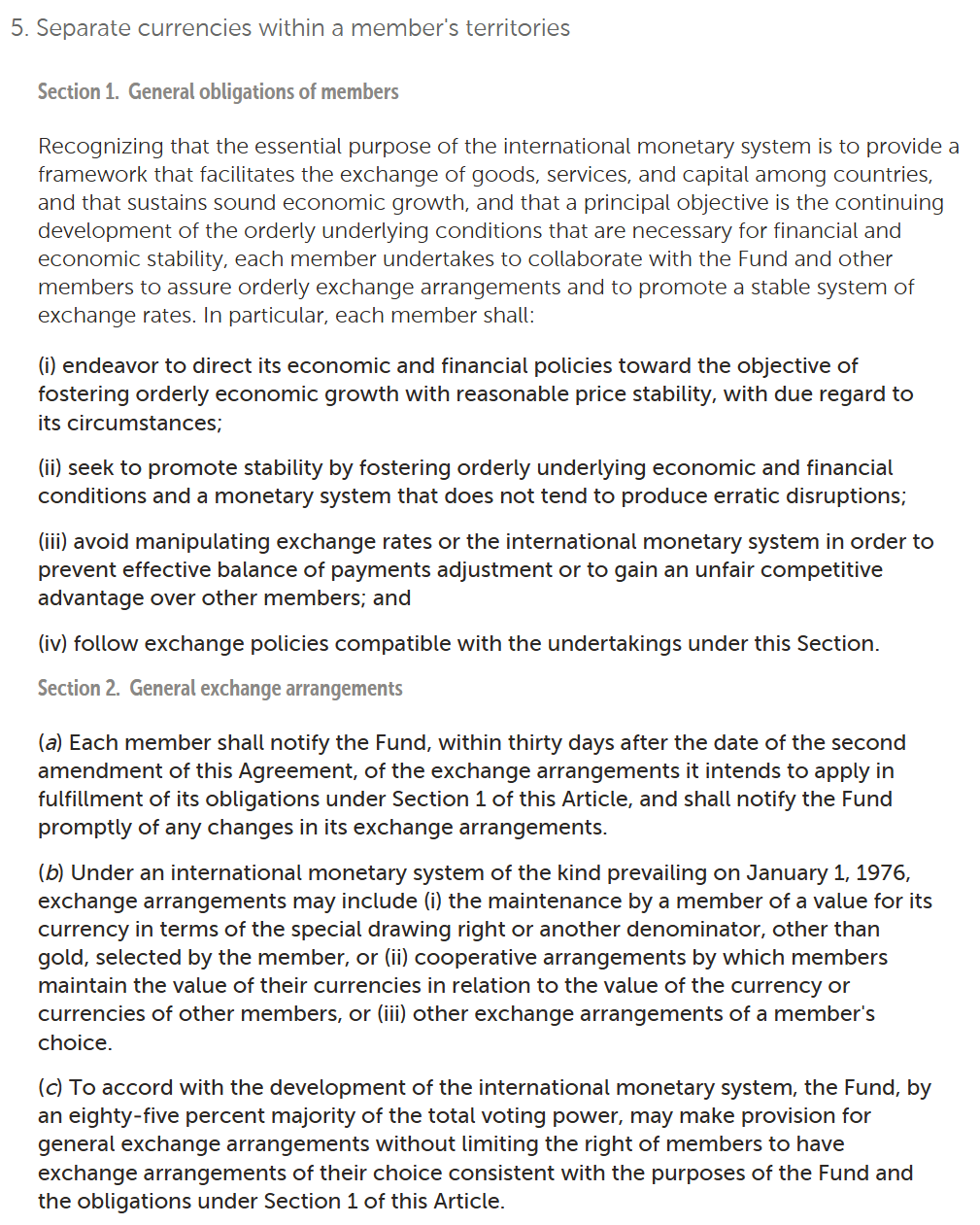
Anyone who reads the statutes of the International Monetary Fund encounters a remarkable passage in Article IV, Section 2(b). It permits member states “the maintenance (...) of a value for its currency in terms of the special drawing right or another denominator, other than gold.”[1]
This seemingly technical formulation is, in truth, a gold prohibition enshrined in international law: no member may peg its currency to gold or settle payments on that basis while remaining part of the IMF system.
Founded in 1944 at Bretton Woods, the IMF was originally created as a guardian of fixed exchange rates under the gold-dollar standard. But after the termination of the Bretton Woods system in 1971 (the Nixon shock of August 15, 1971), its role changed fundamentally: instead of a gold anchor, the concept of Special Drawing Rights (SDRs) was introduced — a synthetic paper reserve medium with no intrinsic value.
With the Jamaica Revision (January 7–8, 1976), the link to gold was not merely suspended but – in legal language – negatively codified: gold was explicitly excluded as a reference point.[2]
The Logic of Exclusion
The phrase “other than gold” is no minor detail. It means that while states may choose any fiat or computational unit (e.g., US dollar, euro, SDR, RWA, basket of currencies), they cannot use the precious metal that has served as natural money for millennia. Thus, within the IMF framework, the gold standard is de jure prohibited.
Under Article IV, Section 3, the IMF also exercises “firm surveillance” over the exchange rate policies of its members and their monetary measures.[3] Any member that pegged its currency to gold would therefore violate the “exchange arrangements” defined by the IMF — a clear reason for diplomatic pressure or the suspension of financial assistance.
This rule is therefore not a neutral “option,” but an implicit sanctioning mechanism against any gold-backed alternative. It remains unclear, however, whether gold could legally form a (minority) component within a basket currency. Other metals such as silver, platinum, or palladium are not explicitly excluded in the current revision of the IMF Statutes.
The Austrian Perspective: The Monopoly of Fiat Money
From the perspective of the Austrian School of Economics, the IMF represents a textbook example of what Ludwig Heinrich von Mises called “institutionalized inflation.”[4] The gold standard restricted governments’ ability to finance deficits through pure money creation. The system of Special Drawing Rights, by contrast, dissolves the final link between money and real value — a form of monetary collectivism that distorts price signals and promotes capital misallocation.
Murray N. Rothbard argued that the transition from the gold standard to fiat money always entails a redistribution of wealth in favor of governments and banks — an “expropriation through inflation.”[5] The IMF cements this condition at the institutional level.
Friedrich August von Hayek viewed supranational monetary regimes as fundamentally incompatible with market freedom. In Denationalisation of Money (1976), he warned that international institutions would eliminate currency competition “under the pretext of stability.”[6] Article IV (2b) is the legal manifestation of that concern.
What Happens During a Fiat System Disruption?
Given rising public debt, de-dollarization, and geopolitical tensions, one might ask: could a return to the gold standard occur in a crisis — for example, through bilateral settlements or commodity backing? In theory, yes; in practice, no — as long as the IMF remains the key institution of the global monetary system and its members adhere to its statutes.
The Fund’s rules explicitly prohibit gold linkage “under an international monetary system of the kind prevailing on January 1, 1976.”[1] Even if individual countries — such as Russia, China, or BRICS members — sought to introduce gold- or commodity-backed settlements, they would have to violate Article IV or withdraw from the Fund.
A withdrawal (under Article XXVI) is possible, but such a state would lose all access to SDR reserves, credit facilities, and multilateral payment mechanisms — a step of enormous political consequence. In an increasingly multipolar world, however, this might become feasible if several actors took it simultaneously.
Thus, the IMF system creates a path dependency: those who stay must play fiat; those who leave risk economic isolation.
The Hidden Irony of the System
Ironically, the IMF clause confirms von Mises’s economic insight:
When money is replaced by government decree, gold must be prohibited — otherwise, the market would eventually return to real money. The prohibition of the gold standard is therefore not a historical accident but a systemic necessity to stabilize the fiat regime.
Yet stability, in the IMF’s sense, does not mean price stability but systemic stability — the maintenance of a debt architecture that would collapse without permanent monetary expansion. The “surveillance of exchange rate policies” (Article IV, Section 3) serves not coordination but discipline. Any return to market-driven, asset-backed money would pose an existential threat to the institutionalized credit-money system.
Conclusion: A Gold Standard Would Be Contrary to the IMF System, Not Consistent With It
The analysis of Article IV (2b) demonstrates that the IMF has rendered a return to gold not only practically but legally impossible. In a scenario of global fiat disruption, the institution’s response would not be liberalization but further centralization — likely through expanded SDR issuance or the introduction of digital reserve units.
The Austrian School would therefore conclude that genuine monetary competition can emerge only outside the existing system — through free currency choice, private gold or crypto reserves, and the rejection of central monetary planning. In von Mises’s words: “The return to gold is not a technical problem but a moral one — the restoration of freedom of contract in money.”[7]
References
[1] IMF Agreement, Article IV, Section 2(b), 2020 edition, p. 6, https://www.imf.org/external/pubs/ft/aa/
(accessed January 1, 2025).
[2] Jamaica Accord, Second Amendment to the IMF Articles, April 1978.
[3] IMF Articles of Agreement, Article IV, Section 3(b).
[4] Ludwig von Mises, Human Action (1949), Chapter XVII.
[5] Murray N. Rothbard, What Has Government Done to Our Money? (1963).
[6] Friedrich A. von Hayek, Denationalisation of Money (1976), pp. 19–22.
[7] Ludwig von Mises, The Theory of Money and Credit (1912), p. 470 ff.
2025
IMF | GOLD
Kai Baumgartner
The IMF Warns. But Whom Exactly?
In October 2025, the IMF (International Monetary Fund) warns central banks that they are losing trust. They fear that this loss of confidence could turn into high inflation. But that’s not the real warning. It goes far deeper.
Central banks themselves are not living beings. They are buildings, computers, and bureaucratic hierarchies. So how can one “lose trust” in a building, a chair, or a spreadsheet? You can’t.
The real loss of trust concerns the assets and promises that central banks hold. And those promises are nothing but government bonds — the IOUs of states that have promised to pay tomorrow what they cannot afford today: “I owe you” = they owe us
The Core of the Problem
A central bank is nothing more than the guardian of its government’s credit. It sits on mountains of public debt, pretending that this pile of promises has real value. But when people start to doubt the value of those promises, the façade collapses. To lose trust in a central bank is, in truth, to lose trust in government debt itself.
Let’s take the United States—the issuer of the world’s “risk-free” asse —as an example.
- Public debt: $38 trillion
- New debt each year: $2–3 trillion
- Interest payments: $1.2 trillion per year
- Annual tax revenue: $5 trillion
That means the government collects only one-seventh of what it owes — and the gap widens every year. By 2030, every cent of U.S. tax revenue will go to mandatory expenses: interest, healthcare, veterans, social programs.
There will be nothing left. No surplus. No repayment. Only more debt. So what is the value of an asset whose issuer cannot possibly honor it? The answer is self-evident: zero.
The Real Warning
So why is the IMF warning now?
Because its own empire is trembling.
The IMF’s greatest rival has returned — not another institution, but a timeless one: Gold. When the IMF was created in 1945, its purpose was clear — to replace gold as the world’s reserve asset with U.S. government bonds. Gold pays no interest, they said. Bonds do. And for decades, the world believed that story. But reality has a habit of returning. As people rediscover that interest without repayment is an illusion, gold has staged its quiet revenge. In just one year, gold’s global market value has surged by $10 trillion. At $4,000 per ounce as of October 2025, gold has overtaken U.S. Treasuries as the world’s preferred reserve asset.
The IMF is not warning central banks.
It is warning itself.
The Inevitable Future
At 10% annual appreciation, gold will reach $16,000 per ounce by 2040. Not through speculation—through mathematics. The paper promises of governments are dying. The real money of civilization—gold—is reclaiming its role.
As Ludwig Heinrich von Mises once wrote: “There is no means of avoiding the final collapse of a boom brought about by credit expansion”
The IMF knows it.
Central banks feel it.
And the market has already decided.
What about you?
References
[1] Erosion of trust in central banks can boost inflation expectations, IMF warns, Reuters, October 14, 2025
2025
MARKETS | GOLD
Kai Baumgartner
PHYSICAL DELIVERABILITY IN THE GOLD FUTURES MARKET
With gold prices surpassing $4,300 per ounce in October 2025, it is worth examining a structural vulnerability in the precious metals market that many investors overlook. It concerns the extreme imbalance between traded paper claims on gold and the amount of physical gold actually available—a phenomenon that closely resembles the fractional reserve system in banking. This fragility of the “paper gold” market could have dramatic consequences in a crisis. The paper-to-physical ratio covers only a fraction of outstanding claims.
A 100:1 Ratio Between Gold Futures and Physical Gold
Current estimates suggest that trading in “paper gold” (futures, certificates, ETCs, ETFs, and similar instruments) exceeds actual physical gold holdings many times over. Experts frequently cite ratios of at least 100:1—and in certain market segments, even as high as 200–250 to 1. In other words, for every physical ounce of gold, there may be hundreds of paper ounces circulating as claims. Even a study by the European Central Bank (ECB) confirms that the global gold market effectively functions as a fractional reserve system—with more than one hundred paper claims on every ounce of real gold. This discrepancy is worth reflecting on.
The Delivery Question
What happens if even a modest percentage of paper gold investors were to demand physical delivery simultaneously? The math is sobering: If only 5% of paper gold holders at a 200:1 ratio requested delivery, that would amount to ten times more gold than physically exists. In such a scenario, not all claims could be met—some investors would literally be left without a chair when the music stops. Analysts warn that in the event of a broader loss of confidence, many holders of gold ETCs, ETFs, and futures would demand delivery to obtain the metal physically. When multiple claims exist on the same gold bar, some investors might not receive their metal on time—if at all. Storage facilities would first have to recall leased inventory—a process unlikely to run smoothly in times of stress. Ironically, such a delivery run would occur precisely when everyone simultaneously seeks the safety of physical possession—for instance, during systemic crises or hyperinflation.
The Hidden Counterparty Risk
Major gold ETFs and futures exchanges are prepared for such scenarios—though not necessarily to the benefit of investors. The contractual terms of many such products contain clauses allowing for cash settlement instead of physical delivery in exceptional circumstances. In other words, in the event of “market disruptions,” issuers reserve the right to pay investors in cash rather than bullion. This fine print effectively constitutes counterparty risk—precisely the kind of risk that physical gold is meant to hedge against.
No Mere Theory
These risks are not abstract theory. Time and again, market disruptions have provided glimpses of what a delivery run might look like. A striking example was the 2022 nickel crisis: In March 2022, the London Metal Exchange was forced to take drastic measures as nickel prices skyrocketed. Trading was halted, transactions were canceled, and the physical delivery of due contracts was postponed because available inventories could not meet delivery obligations. At the time, one analyst pointedly asked whether this could still be called a “functioning market” if the “market of last resort” could not provide the inventory to deliver [1].
Similarly, in March 2020, the New York gold market experienced a historic shortage. Refiners were closed and transport routes disrupted due to pandemic restrictions, while demand for gold surged. Open interest in the April gold future reached nearly 200,000 contracts (equivalent to roughly 19.6 million ounces), whereas COMEX inventories listed only about 8.7 million ounces as immediately deliverable . The result: The New York futures price soared to the highest premium over the London spot price since the 1980s (temporarily about $67 per ounce above spot)—a clear sign of physical scarcity. Market observers described it as a historic squeeze—“never in a generation” had such a decoupling been seen. It took coordinated efforts among market participants (including the temporary acceptance of 400-ounce bars on COMEX) to stabilize the situation.
Similar tensions were also seen in the silver market. In early 2021, retail investors attempted to trigger a “short squeeze” in silver, resulting in record inflows into the largest silver ETF. The issuer was forced to amend its prospectus on February 3, 2021, stating: “Demand for silver may temporarily exceed the available supply acceptable to the Trust” [2]. In other words, the provider acknowledged that, in the event of continued scarcity, the creation of new ETF shares could be suspended or limited.
The Uncomfortable Reality
Investors—especially those holding gold as insurance against financial market risk—should clearly understand what they actually own. Paper gold offers undeniable advantages: high liquidity, low transaction costs, and convenient portfolio handling. At the same time, it carries distinct risks.
Counterparty Risk and Dependence on the Financial System: The value of paper gold claims depends on the solvency and willingness of the issuers. Paper gold is ultimately a promise—and a promise is only as good as the ability to honor it when it matters. If a broker, bank, or ETF becomes insolvent, the investor is left with a claim, not a tangible asset. The Austrian School of Economics has long emphasized that such reliance constitutes a concentration risk—analogous to fractional-reserve banking, where more claims circulate than reserves exist.
Possible Cash Settlement Instead of Physical Delivery: Exactly in the stress scenario for which gold is meant as a hedge, paper gold may lose its promised convertibility. Contracts allow issuers, under exceptional circumstances, to settle in cash instead of metal. The investor might then receive a payment—but no gold—precisely when physical metal would be most sought after, such as during a currency crisis.
Systemic Market-Structure Risks: The enormous leverage and rehypothecation of the same gold inventories make the system vulnerable to shockwaves. The ECB warns that “in the event of extreme circumstances, adverse effects on financial stability could emanate from the gold market” [3]. A sudden deleveraging—the flight from paper positions into physical assets—could create liquidity shortages and transmit shocks to other markets. A significant divergence between paper and physical gold ultimately undermines confidence in gold-backed financial instruments.
In short, those who believe they are safely hedged against a “crash” through a gold ETF or future should read the fine print carefully. The uncomfortable reality is that many of these structures contain mechanisms that may activate precisely when gold is needed most. From the perspective of the Austrian School, only physical gold fully meets the definition of sound money: it is a real asset, not a promise, and ownership is independent of third parties.
A Final Question
With gold prices soaring and uncertainty mounting, one must ask whether the risk of paper gold being non-convertible into physical metal is adequately priced into the market. For investors who hold gold as insurance against systemic crises, it is worth examining whether their “insurance policy” might include clauses that prevent payout in real assets precisely when it matters most. Put differently: Do you truly own gold—or just a piece of paper that says you do?
To be clear, this is not a call to abandon paper gold entirely—it serves important functions for trading and liquidity. However, a prudent strategy might involve diversifying within one’s gold allocation: keeping a solid portion in physical form (stored securely, ideally outside the fiat banking system) and using paper instruments primarily for shorter-term trading purposes.
References
[1] Reuters (2022): "Nickel Trading Chaos Forces LME to Cancel Trades"
[2] Bullion.Directory (2021): "SLV Prospectus Updated Amid Silver Squeeze"
[3] Kitco News (2024): "ECB: Leveraged Gold Markets Pose Stability Risks"
2026
MARKETS | GOLD
Kai Baumgartner
M&A IN THE GOLD MARKET: CONSOLIDATION, ACCESS TO CAPITAL AND STRATEGIC REPOSITIONING
The European precious metals market is entering a new phase of consolidation. Driven by economies of scale, tighter regulation, digital transformation and growing institutional demand for transparency and liquidity, companies are repositioning strategically. Capital market transactions are becoming a key growth driver.

Five recent examples:
Bullion International Group (MKS PAMP GROUP): Following its majority acquisition of SOLIT Group AG in early 2026, the group secured immediate access to the German market. SOLIT is among Germany's leading physical bullion providers.
FIDEX Metals: The acquisition of NobleGold strengthens FIDEX's trading and processing capabilities. Together with shareholders C. Hafner and Ziemann Valor, the company combines industrial refining expertise with trading and logistics capabilities.
Gens Aurea S.p.A.: The planned Milan IPO values the company at approximately EUR 1 billion, according to Reuters. In 2025, Gens Aurea generated more than EUR 830 million in revenue and EUR 105 million in adjusted EBITDA. Its retail network is expected to expand from 530 to around 830 locations.
Gold.com (NYSE: GOLD): The company acquired a 49.5% stake in Atkinsons Bullion & Coins (UK), with an option to increase ownership to 75% by 2028.
A Global Player: A multi-billion-euro precious metals company known to me is conducting a structured equity process, offering investors up to 40% of its share capital. An Asian Tier-1 investor has already provided a soft commitment for up to a 20% stake, representing a transaction in the mid-hundreds of millions.
Conclusion
The current M&A wave reflects a market-driven selection process. Capital continues to flow toward the most efficient owners, while scale, reputation and access to capital increasingly determine competitive advantage. Against a backdrop of higher public debt, expansionary monetary policy and geopolitical uncertainty, physical gold is reasserting its role as a monetary asset.
Companies consolidating capital, refining capacity, distribution and customer access today will not only gain market share but also secure control over critical parts of Europe's value chain through vertical integration, while continuing to capitalize on long-term opportunities across emerging markets.
2026
LOCATIONS | LIECHTENSTEIN
Kai Baumgartner
LIECHTENSTEIN’S TAX CD 2.0 MOMENT: REGISTER OF BENEFICIAL OWNERS COMPROMISED
The cyberattack on Liechtenstein’s Register of Beneficial Owners (VwbP / UBO) is more than an IT incident. It is a test of the country’s institutional credibility. In 2008, the old promise of tax-related discretion vis-à-vis foreign authorities collapsed. In 2026, the new promise is being tested: combining legally compliant transparency with the effective protection of legitimate privacy.
What matters now is whether Liechtenstein responds faster, more transparently, more consistently and, ultimately, more professionally than competing financial centres. In this business, trust is not a soft factor. It is an economic currency that extends far beyond the formation of a task force.

EXECUTIVE ASSESSMENT
The confirmed facts are serious, but more limited than some headlines suggest. According to the government, copies of records relating to approximately 31,000 legal entities were extracted. This figure does not necessarily represent 31,000 individual natural persons.
The target was a government compliance register; there is no evidence that the banking system itself was compromised. The registry contains, in particular: the names of the legal entities, the last and first names of the beneficial owners, date of birth, nationality, and country of residence. To date, there are no indications that bank accounts, custody accounts or assets were accessed, altered or withdrawn. Nor does being listed as a beneficial owner indicate any unlawful conduct.
The strategic damage arises from the linkages within the data. Names, dates of birth, nationalities and countries of residence can be connected to companies, foundations and trusts. When combined with external data, ownership and relationship networks could potentially be reconstructed in full.
The market will assess the response above all else. Speed, precision, independent investigation and visible consequences will determine whether this security incident develops into a lasting crisis for Liechtenstein as a business location.
WHAT HAS BEEN CONFIRMED SO FAR
According to preliminary findings, an unidentified threat actor gained unlawful access to the Register of Beneficial Owners, or VwbP, during the night of 30 July 2026.
The entry point was the very portal through which legal entities submit their statutory filings. The attackers exploited a technical vulnerability, created their own user account, escalated their privileges and exfiltrated the data not through a single bulk download, or data dump, but over several hours using thousands of individual queries: record by record. Beyond the technical vulnerability and the broader design weaknesses of the overall concept, this points to a third failed layer of control: unusual query patterns, access rates and data outflows were apparently neither detected in time nor effectively blocked.
The Office of Justice detected irregularities later that day. The Office of Information Technology initiated containment measures and took the system offline. The government was informed of a potentially successful attack on 31 July; the first confirmed findings became available on 1 August. A crisis team led by Prime Minister Brigitte Haas and Minister of Justice Emanuel Schädler commenced its work. This timeline is set out in the government’s official statement (1).
The exfiltration of copies of data relating to approximately 31,000 legal entities has been officially confirmed. Based on current information, there are no indications that data were altered or deleted. At the editorial cut-off, the identity of the perpetrators, initial access vector, motive, dwell time and full scope of the incident had not been disclosed publicly. According to SRF’s reporting on the government’s press conference (2), no ransom demand had been received and no known offer of the data had appeared on the dark web.
The VwbP has been maintained since the relevant legislation entered into force in 2021 to combat money laundering and terrorist financing. It implements requirements under the EU’s Fifth Anti-Money Laundering Directive. This background makes the incident politically sensitive: a register created to deliver transparency has itself become a risk to confidentiality.
2008 AND 2026: THE SAME ECONOMIC LOGIC, A DIFFERENT SYSTEM
In 2008, former bank employee Heinrich Kieber stole confidential data. Germany’s Federal Intelligence Service, the BND, acquired the material for EUR 4.6 million. The affair became public with the high-profile arrest of then-Deutsche Post CEO Klaus Zumwinkel and dramatically increased international pressure on Liechtenstein. It culminated in the 2009 Liechtenstein Declaration and the principality’s systematic clean-money strategy.
By 2010, 596 investigations had been initiated on the basis of the bank data. Voluntary disclosures generated EUR 626 million, although approximately two-thirds of that amount was not directly attributable to the bank case. A further EUR 181 million was collected from the cases completed by that point. The bank also made a payment of EUR 50 million. The figures and subsequent reforms are documented by the Historical Lexicon of the Principality of Liechtenstein (3).
The parallel with 2026 lies not primarily in tax law. It lies in the economic nature of data: once copied, they can cross institutions and borders at virtually zero marginal cost. Their use can neither be reliably reversed nor limited in time.
The key difference is even more important. In 2008, the issue was the disclosure of allegedly undeclared assets to tax authorities. Liechtenstein now operates within a system of automatic information exchange and international tax cooperation. The current dataset therefore cannot be characterised indiscriminately as a list of “tax evaders”.
Its risk profile instead ranges from targeted phishing and identity misuse to extortion, physical security threats and commercial or intelligence-led network analysis. These are plausible harm scenarios, not confirmed uses of the data to date.
TRUST IS A CURRENCY
Trust is not the product of a government declaration. It emerges in a decentralised manner through repeated experience, verifiable performance and credible accountability. In financial centres, trust reduces the cost of due diligence, contractual controls and ongoing monitoring. It increases the duration of client relationships and lowers a jurisdiction’s risk premium.
Reputational damage consequently acts like an invisible tax: clients demand additional checks, banks and fiduciaries invest more heavily in controls, insurance premiums rise, new mandates are delayed and mobile wealth considers alternative jurisdictions. The cost rarely appears on an invoice, but it materialises through higher transaction costs and lost new business.
The incident also exposes a classic incentive problem. Beneficial owners are legally required to submit their data, yet they can neither choose the storage location, system architecture and service providers nor price the associated risk. The state captures the regulatory benefits of centralisation, while a significant share of the potential downstream costs is borne by the affected individuals. Where competition is absent as a disciplinary mechanism, it must be replaced by independent scrutiny, clear accountability, measurable security standards and effective liability.
This is not an argument against combating money laundering. It is an argument against the assumption that maximising data collection comes at no cost. Each additional piece of information may increase regulatory insight, but it also raises the value of the target. A central “single source of truth” can become a single point of failure.
European case law also recognises this trade-off. In 2022, the Court of Justice of the European Union invalidated unrestricted public access to UBO data because of the serious interference with privacy and data-protection rights (4). Liechtenstein’s 2025 government report also refers to EFTA case law under which access requires a legitimate interest and must be appropriate, necessary and proportionate (5).
A successful cyberattack bypasses precisely these legal safeguards. The relevant choice is therefore not transparency versus secrecy, but purpose-bound transparency versus uncontrolled disclosure.
EU ASSET REGISTRY: WHEN TRANSPARENCY BECOMES A SYSTEMIC RISK
Against this background, the EU-level project to link transparency and asset information also warrants a stricter cost-benefit assessment. A 2024 feasibility study published for the European Commission examines a single access point through which authorities could reach relevant Member State asset registers, and assesses three operational, legal, IT scenarios.
The potential benefit is faster cross-border asset tracing. The counter-risk is equally real: the more interoperable, comprehensive and centrally queryable the data become, the higher the target value, scope for misuse and maximum loss from a single control failure. Before any further integration, data minimisation, tiered access, strict purpose limitation, independent security testing and effective liability must demonstrably precede technical scaling (6).
FINANCIAL SERVICES: ECONOMICALLY SECONDARY, REPUTATIONALLY DEFINING
Liechtenstein is not a purely financial economy. According to the Financial Market Authority, industry accounted for approximately 42% of gross domestic product in 2022, compared with only around 17% for financial services, including related professional services (7). The International Monetary Fund estimates that the more broadly defined financial sector represents approximately 20% of GDP and 17% of employment. Measured by managed and balance-sheet assets, however, the sector amounts to roughly 100 times the country’s annual economic output (8).
Financial services are therefore secondary to industry in quantitative terms, but they remain the country’s international shop window. A precision tool from Schaan or a dental product from the Unterland rarely generates a global headline about Liechtenstein. A data breach involving a foundation and UBO register does so immediately. The financial centre does not represent the country’s entire economic balance sheet, but it is a disproportionately important carrier of the Liechtenstein brand, extending all the way to the Princely House.
CYBERSECURITY: A KEY PRIORITY FOR THE CURRENT GOVERNMENT
Even before this incident, the FMA had warned that structural and reputational risks were central to the stability of the financial centre and that cyberattacks were becoming more frequent and complex. The Princely House and the government have likewise prioritised cybersecurity during the current legislative term. The attack therefore does not concern an overlooked peripheral risk, but a strategic field of action that has been recognised for years.

WHAT MUST HAPPEN NOW
1. Establish the Facts Within Days, Not Months
The government should publish rolling updates with clear timestamps, specifying:
- which data fields, reporting dates and historical versions were affected;
- how many unique natural persons and legal entities are affected;
- when the initial access occurred and how long it remained undetected;
- whether credentials, interfaces, service providers or additional portals were affected; and
- what volume of data was actually exfiltrated and what forensic evidence has been secured.
Where facts remain unavailable, they should be explicitly labelled as unknown. Precise uncertainty creates more trust than premature reassurance.
2. Protect Affected Individuals According to Risk Category
A standard notification will not be sufficient. Targeted warnings about phishing, identity misuse and social engineering are required, alongside a central point of contact and coordinated monitoring for possible publication of the data. Individuals facing elevated risks of extortion, kidnapping or sanctions exposure require a separate security assessment. By establishing and communicating a dedicated email address during its first media briefing, the government has already taken an initial step (1).
3. Commission an Independent Forensic Investigation
The final report should identify, at a minimum, the attack vector, dwell time, scope of the affected data, control failures, the role of external providers and concrete remediation measures. Sensitive technical details may require protection; the causes, accountability and effectiveness of the controls do not. A state cannot demand transparency from private actors while responding to its own control failure with lasting opacity.
4. Redesign the Architecture
Required measures include data minimisation, short retention periods, segmented access rights, strong multi-factor authentication, separated key management, field-level encryption, immutable logs, effective exfiltration alerts, regular red-team testing and more rigorous supply-chain reviews. Authorities should also examine whether queries can be answered in a more purpose-bound or decentralised manner, or through cryptographic attestations, without unnecessarily exposing the complete raw dataset.
Decentralisation is not an end in itself. It is an instrument for limiting maximum potential damage.
5. Rebuild Trust Through Verifiable Performance
The relevant benchmark is not the number of new strategy papers, but demonstrable improvements in detection time, response time, access discipline and data minimisation. Independent audits, published performance targets and parliamentary oversight would create the feedback mechanism that a state monopoly register otherwise lacks because it is not exposed to competition.
CONCLUSION
- In 2008, Liechtenstein was forced to shift its business model from tax-related opacity to international compliance. In 2026, the country must demonstrate that digitised compliance does not end in centralised vulnerability.
- The attack is not yet a second tax-CD scandal in terms of its legal consequences. It is, however, a Tax CD 2.0 moment in strategic terms: it demonstrates that data have themselves become a tradable asset and an attack surface area for a financial centre.
- Liechtenstein will not be judged on whether it was attacked. It will be judged on whether it centralises responsibility after having centralised the data.
- Trust is the hardest currency. Trust cannot be legislated. It must be earned time and again in the market.
SOURCES
- Government of the Principality of Liechtenstein: Unauthorised Third-Party Access to Register Data, 2 August 2026
- SRF: Cyberattack on Economic Data in the Principality of Liechtenstein, 2 August 2026
- Historical Lexicon of the Principality of Liechtenstein: Zumwinkel Affair
- Court of Justice of the European Union: Judgment on Public Access to UBO Registers, 22 November 2022
- Government of the Principality of Liechtenstein: Government Report 2025
- European Commission / Publications Office of the European Union: Feasibility Study for a European Asset Registry in the Context of the Fight Against Money Laundering and Tax Evasion, 10 July 2024
- Financial Market Authority Liechtenstein: Financial Stability Report 2025
- International Monetary Fund: Liechtenstein 2025 Article IV Consultation
2026
Energy | Renewables
Kai Baumgartner
STATEMENT ON THE STRATEGIC ENVIRONMENTAL ASSESSMENT FOR THE DESIGNATION OF WIND ENERGY AREAS IN LIECHTENSTEIN
The Planning and Environmental Report for the Strategic Environmental Assessment (SEA) does not provide an adequate basis for the final designation of wind energy areas with unresolved conflicts in Liechtenstein. My assessment recommends revising the draft and deferring or excluding areas with unresolved strategic issues until those issues are clarified.
A key link is missing: the planning process must demonstrate how the modelled wind resource translates into electricity that can actually be delivered once all protection requirements are taken into account, what economic value that electricity has and whether this benefit justifies the impacts. Wind power density alone does not answer these questions.
Requirements before final designation
Before any final designation, the following are required:
- independently verified measurement data and energy yields after accounting for all protection requirements;
- a full cost assessment covering grid connection, balancing energy, financing and decommissioning;
- an integrated assessment of local conflicts relating to species protection, noise and other environmental disturbances, and landscape impacts;
- clear liability arrangements and financial security that remains effective in the event of insolvency.
Implications for the National Spatial Plan
Before the final designation of wind energy areas with unresolved conflicts, conservative net energy yields, full costs and contributions to energy supply must be substantiated independently. Local conflicts and the cumulative effects of multiple projects must be assessed transparently. Alternative energy portfolios must be compared on the basis of identical objectives.
As long as matters of strategic significance remain unresolved, the affected areas must be deferred or excluded. Public assets and citizens’ capital must not be committed through an advance spatial planning decision on the basis of an inadequately substantiated benefit.
Sources
The complete statement contains the calculation assumptions, the counter-assessment of individual areas, specific requests for amendments and 33 numbered references. It draws on the SEA draft dated 30 June 2026, including its species annex, official documents and original scientific studies.
ADDRESS
Munich, NYC, Singapore, Vaduz, Zug
Appointments by arrangement only
CALL
On appointment